Length of a Circle: Iterative Numerical Approximation (Ver.0)
The equation of a general circle centered at the point

with radious  is
is

it is known that its length is  . We want to approach the actual length by an increasing value of the inscrived polygon length.
Contents
Iterative approach
Let's illustrate the idea by the following plot:
imagePlot('circleLength.png',100); %private function to show images, not needed
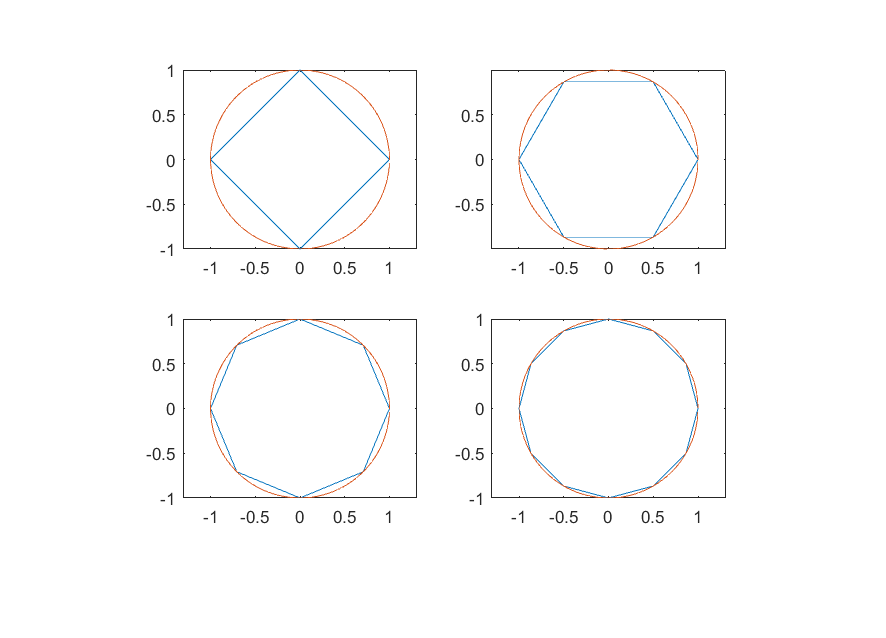
First version
We are now taken the first approximation: An inscribed square
Create a new sript file and named it as circleLengthV0.m
radious = 1;
%Define a 4x2 points table p_i=[x_i,y_i]
points = [radious,0;
         0,radious;
        -radious,0;
        0,-radious]
[m,n] = size(points)
points =

     1     0
     0     1
    -1     0
     0    -1


m =

     4


n =

     2
m rows (number of points) and n columns (number of coordinates)
Now we compute the length of the closed curve associated to this polygon.
Each edge has length

leng1 = 0;
for i = 1:m
    if (i < m)
        leng1 = leng1+sqrt((points(i+1,1)-points(i,1))^2+(points(i+1,2)-points(i,2))^2);
    else %closed curve: joint last point with first one
        leng1 = leng1+sqrt((points(1,1)-points(i,1))^2+(points(1,2)-points(i,2))^2);
    end
end
leng1
leng1 =

    5.6569
Using Matlab functions (in this case norm) we can reach the same result
leng2 = 0;
for i = 1:m
    if (i < m)
        leng2 = leng2+norm(points(i+1,:)-points(i,:));
    else %closed curve: joint last point with first one
        leng2 = leng2+norm(points(1,:)-points(i,:));
    end
end
[leng2, leng1-leng2]
ans =

    5.6569         0
Finally the error obtained by the present approximation is:
actualLength = 2*pi*radious;
absError = abs(leng2-actualLength);
relError = absError/actualLength;
[absError,relError]
ans =

    0.6263    0.0997
First exercise
Pass the computation of the length of the polygon to a function file named it as curveLength.m
function cLength = curveLength(points,numPoints)
Second exercise
As a first exercise reproduce the previous computation for the Octagon using now  . This means that the points are the previous ones plus the ones associated to angle
  which are

and the appropriate change of signs according to the associated quadrant.
Solution=
length= 30.6147 absError = 0.8013 relError = 0.0255
(c) Numerical Factory 2017