Contents
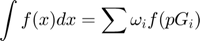
1D Gaussian Quadratures
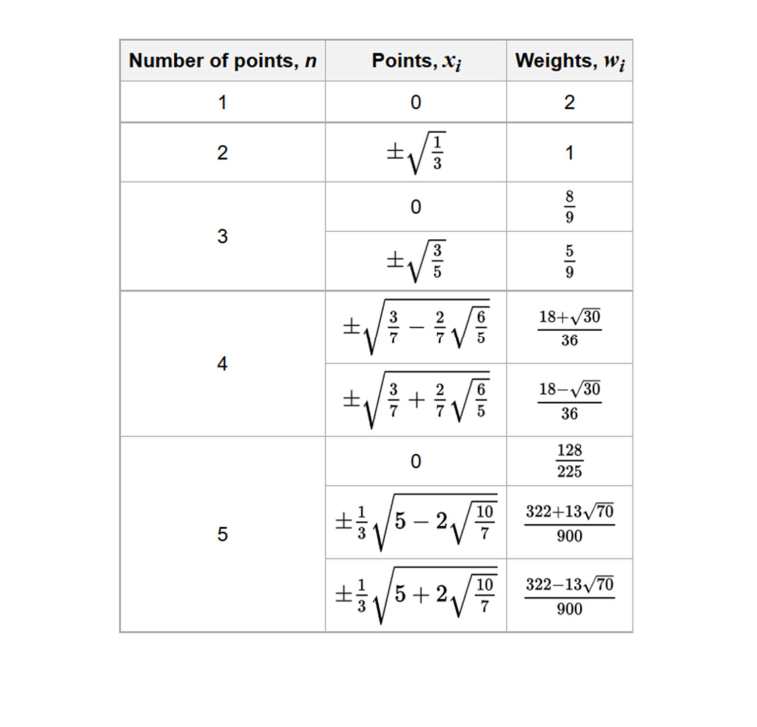
We will implement a function that give us the associated Gauss quadrature points and their weigths.
We will apply this to the computation of the integral of a polynomial funcion (exact) and general functions (approximate).
imagePlot('GaussTable.png',100);
Function to integrate
Let's consider the function

f=@(x) x.^4-3*x.^2+1; %defined as inline function
or as a file function
function y=f(x)
y=x.^4-3*x.^2+1;
Order of integration (number of Gauss points)
As you increment n the formula is exact for polynomials of degree 2n-1.
n=3;
switch (n)
    case 1
        w=2; pG=0;
    case 2
        w=[1,1]; pG=[-1/sqrt(3), 1/sqrt(3)];
    case 3
        w=[5/9, 8/9, 5/9]; pG=[-sqrt(3/5), 0, sqrt(3/5)];
    otherwise
        error('No data are defined for this value');
end
The final formula
You can use a sequential formula
sumat = 0;
for i=1:size(pG,2)
    sumat = sumat + w(i)*f(pG(i));
end
intFseq = sumat
intFseq =

    0.4000
or equivalently, a compact form of the same value
intFcompact = sum(w.*f(pG))
intFcompact =

    0.4000
Check the error against the actual value
primitiveF=@(x) x.^5/5-x.^3+x;
barrowRule=primitiveF(1)-primitiveF(-1);
errorInt = abs(barrowRule - intFcompact)
errorInt =

   2.2204e-16
Exercise 1:
make the assignment of the Gauss points and weight values a Matlab function for n=1,..5 (check n <=5, bigger values are not allow, use the following sentence).
error('No data are defined for this value');
According to the table included above you have to implement and get the results:
function [w,pt] = gaussValues1D(n)
imagePlot('GaussTable.png',100);
for n=1:6 %for n=6 must return an error
    n
    [w,pt]=gaussValues1D(n) %function to be implemented
end
n =

     1


w =

     2


pt =

     0


n =

     2


w =

     1     1


pt =

   -0.5774    0.5774


n =

     3


w =

    0.5556    0.8889    0.5556


pt =

   -0.7746         0    0.7746


n =

     4


w =

    0.6521    0.6521    0.3479    0.3479


pt =

   -0.3400    0.3400   -0.8611    0.8611


n =

     5


w =

    0.4786    0.4786    0.5689    0.2369    0.2369


pt =

   -0.5385    0.5385         0   -0.9062    0.9062


n =

     6
Error using gaussValues1D (line 19)
No data are defined for this value

Error in Gauss1D (line 71)
    [w,pt]=gaussValues1D(n) %function to be implemented
Exercise 2:
Using the function gaussValues1D, approximate the value of the integral in [-1,1] of the function f(x)=cos(x). Use different values of n and show the errors comparing with the true value 2*sin(1)
Sol:
n, error
1 3.1706e-01
2 7.1183e-03
3 6.1578e-05
4 2.8092e-07
5 7.9140e-10
(c) Numerical Factory 2016